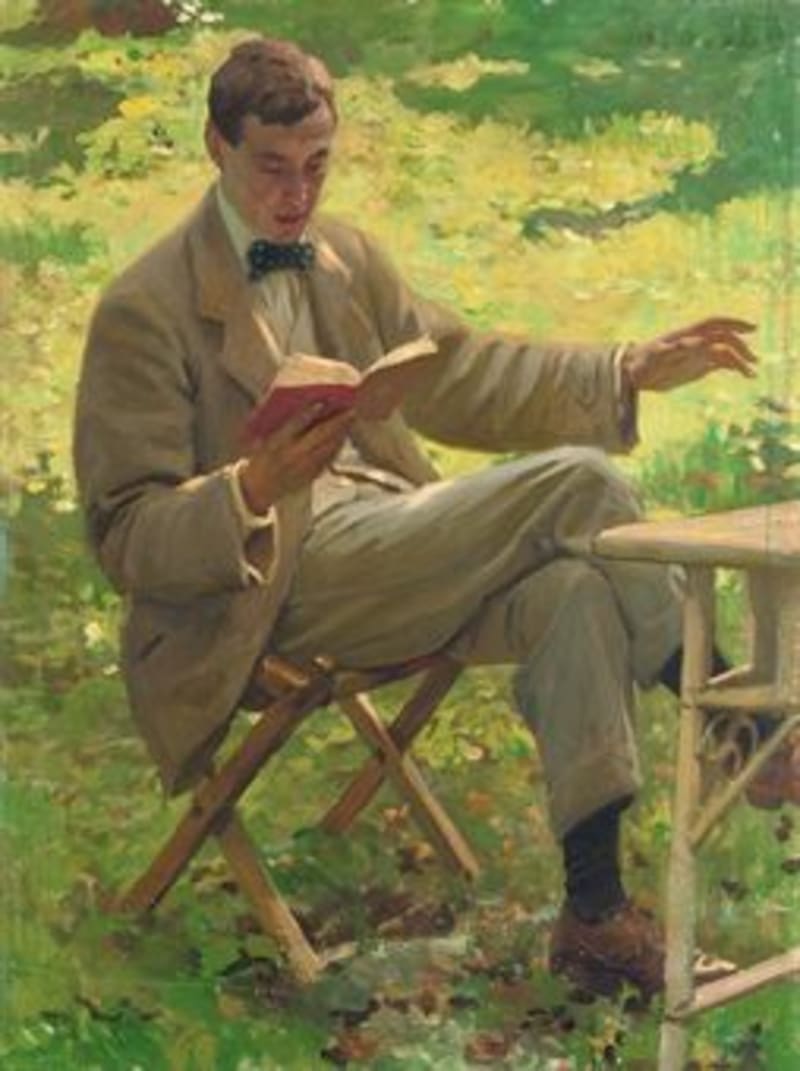
Alfred Munnings painted horses the way Stubbs painted them — with anatomical truth and complete authority — but with the windows open. Where Stubbs studied his subjects in still, scholarly light, Munnings dragged his easel out into the field. Wet grass under his boots. Cold morning air on the canvas. Hounds working a hedgerow in the distance. The result is sporting art that doesn't just describe an animal; it describes the day the animal was in.
He was the most successful animal painter of the early twentieth century. He served as President of the Royal Academy from 1944 to 1949. He was knighted. American collectors paid him sums that would embarrass most of his contemporaries, and his canvases of polo ponies, hunters, and gun dogs ended up in some of the finest country houses on two continents.
But the reason his name still sells today, more than sixty-five years after his death, is simpler than any of that. Munnings made animals feel alive. You can almost hear the bridle.
A Life in Brief — Suffolk, the War, and the Royal Academy
Alfred James Munnings was born in 1878 in the Suffolk village of Mendham, the son of a miller. He was apprenticed at fourteen to a Norwich lithographer, drawing posters and ad work — discipline that would later show up in the confident, decisive line of his finished oils. He studied at the Norwich School of Art and then in Paris at the Académie Julian.
At twenty, an accident with a thorn branch cost him the sight of his right eye. Most painters would have stopped. Munnings did not. He simply learned to compose with one eye and kept going for another six decades.
In 1918, having been rejected from active military service because of his blindness, he was appointed an official war artist attached to the Canadian Cavalry Brigade in France. The work he produced there — most famously Charge of Flowerdew's Squadron — is among the finest cavalry painting of the twentieth century and put his name in front of a global audience for the first time.
The 1920s made him rich. American industrialists and English aristocrats commissioned portraits of their hunters and polo strings at prices that climbed steadily through the decade. He was knighted in 1944, took up the Presidency of the Royal Academy the same year, and held it until 1949. He died at his home, Castle House in Dedham, in 1959, having painted almost to the end.
What Made the Munnings Style Different
Most equestrian and sporting painters before Munnings worked the same way: bring the animal in, pose it, light it from the studio window, paint it against an invented backdrop. The tradition went back to the eighteenth century and it produced some of the loveliest dog and horse portraits ever made. But it was, by the time Munnings inherited it, a quiet tradition. Polite. Indoor.
Munnings broke three things at once.
He painted in outdoor light. Real daylight is colder, harder, and more interesting than studio light. It picks out the wet shine on a flank, the gold on a hound's coat at four in the afternoon, the cool blue in shadow under a horse's belly. Munnings painted what he actually saw, and his canvases hum with weather.
He painted speed. A Stubbs horse stands still and lets you study it. A Munnings horse is going somewhere — cantering up to the start, breaking into a gallop, shifting weight from one leg to another at a fence. The brushwork is loose where it needs to be loose and tight where it needs to be tight, and the eye reads movement before it reads anatomy.
He painted the day, not just the subject. A Munnings sporting scene is never an animal floating in space. It's a horse in a paddock with a particular sky over it. A pointer on a particular field at a particular hour. The animal is the centre of attention, but the world around it is doing real work.
This is why his canvases feel alive in a way that most studio sporting art does not. He let the wind in.
The Munnings Dogs — Pointers, Retrievers, and Hounds in the Field
Munnings is best remembered for horses, but anyone who has spent time with his catalogue knows the dogs are everywhere. Pointers stiffening on game in the long grass. Retrievers standing patient beside a gun. Foxhounds streaming across a winter field in pink coats and a cloud of breath. Terriers waiting under a stable door.
His treatment of dogs follows the same principles as his treatment of horses. The dog is rarely the lone subject of a tight, isolated portrait — that wasn't his instinct. Instead, the dog is doing what dogs were bred to do. Working. Watching. Moving. The hound is a hound first and a portrait second.
What this gives you, as a viewer, is a sense of the animal's purpose. A Munnings pointer isn't decorative. It's working. A Munnings retriever isn't posing. It's waiting for a bird to fall. The dignity in his sporting dogs comes from competence — these are animals doing their proper job in their proper place, and the painter respects them enough to show them that way.
For collectors today, that's a different proposition than the formal studio portrait. It's warmer. It's more honest. And for the owner of a working breed — a setter, a spaniel, a retriever, a hound — it's the most flattering tradition in Western art to have your dog painted in.
Why the Munnings Tradition Appeals to a Different Kind of Collector
Stubbs and Landseer attract one kind of buyer — the collector who wants the formal, composed, almost ceremonial portrait. Wood panelling. Library light. The dog as heraldry.
Munnings attracts a different kind. The sporting-dog owner. The country-house aesthetic. The collector who keeps a Barbour by the door and would rather have a painting that smells faintly of damp tweed and woodsmoke than one that smells of varnish and brass polish. There's more energy in a Munnings. More weather. More sense that the dog in the painting could, at any moment, walk out of the frame.
It also tends to suit a different kind of dog. Working breeds — pointers, setters, retrievers, spaniels, hounds — look right in a Munnings setting. So do gundog mixes, sporting crosses, and any dog that lives an outdoor life. If you've ever come back from a long walk with mud on your boots and a wet dog ahead of you on the path, the Munnings tradition is your tradition.
Where the Work Lives Today
Munnings's most important canvases are held by the Munnings Art Museum at Castle House in Dedham, Essex — his former home, opened to the public in 1965 and still the definitive collection. Major works hang in the Tate, the National Gallery of Canada (the war series), and a number of regional British museums. American collections — Yale, the Virginia Museum of Fine Arts, the National Sporting Library in Middleburg — hold many of the polo and hunting scenes from his lucrative American period.
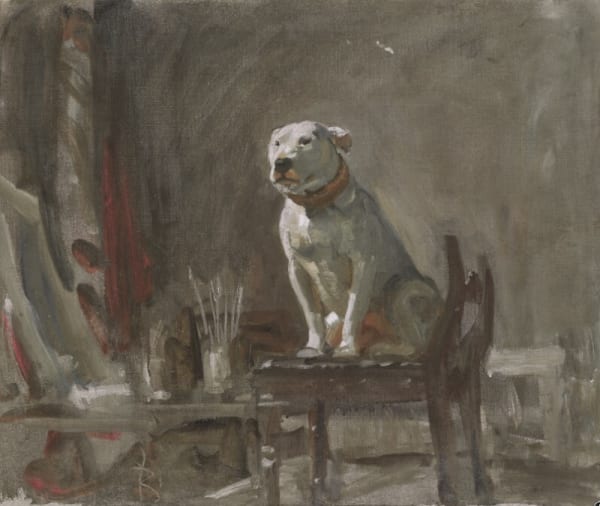
At auction, studio paintings sell for roughly $5,000 to $200,000+, with major sporting canvases occasionally crossing the million-dollar mark at Sotheby's and Christie's. Smaller intimate works like the Bull Terrier "Weller" currently in the European Art sale are exactly the kind of piece that ends up in the dining room of a serious country house, two generations later.